Short answer: AI assistants like ChatGPT, Perplexity, Gemini and Copilot recommend products by searching the web, reading the pages that best answer the question, and quoting or linking them. To be one of those pages, your shop needs its own posts that answer specific questions clearly, with real product details, prices and a short answer at the top. Etsy listings alone are rarely quoted for "what should I buy" questions, because they describe one item rather than answer the question.
How AI assistants choose what to recommend
When a shopper asks ChatGPT "what's a good handmade gift for a gardener under $50?", the assistant usually:
- Searches the web for that question and close variations.
- Reads the top pages, favoring ones that answer directly.
- Writes an answer, naming products, stores or ideas from those pages.
- Cites sources with links the shopper can tap.
Every assistant does this a little differently, but the pattern is the same. The pages that get used are the ones that are easy to quote: a clear answer near the top, specific names and prices, comparisons in tables, and honest detail.
| Assistant | Where its web results come from |
|---|---|
| ChatGPT search | Its own crawler plus search partners, including Bing |
| Perplexity | Its own index and live searches |
| Gemini | Google Search |
| Copilot | Bing |
| Google AI Overviews | Google Search |
So the groundwork is the same as for search engines: be findable on Google and Bing, then be the clearest answer.
Why Etsy listings alone aren't enough
Assistants answer questions. A listing page answers "what is this item and what does it cost". It doesn't answer "which is better for sensitive skin, titanium or sterling silver?" or "what do you get a new homeowner who likes plants?". Pages that answer those are guides, comparisons and gift lists, usually on blogs and stores' own sites.
If your products are featured on such a page, ideally your own, the assistant can recommend them with a link.
What to publish
Write posts that each answer one question a buyer would ask an assistant. The questions tend to be longer and more conversational than Google searches:
| Type | Example question |
|---|---|
| Gift with constraints | "Handmade gift for my sister who loves hiking, under $40" |
| Comparison | "Is linen or cotton better for a summer tablecloth?" |
| Fit or safety | "Are brass earrings OK for sensitive ears?" |
| Care | "How do I clean a sterling silver ring at home?" |
| Occasion | "Unique wedding favors guests won't throw away" |
For each post:
- Answer in the first two or three sentences. Assistants lift this part.
- Name things specifically: materials, sizes, prices, who it suits.
- Use a table for comparisons. Tables are easy to quote correctly.
- End with three or four questions and answers. Each one is a chance to match a follow-up question.
- Keep it true. Don't claim materials or results you can't back up. Assistants increasingly check claims across sources.
Make your pages easy to read for machines
- A sitemap so crawlers find every post.
- Structured data for articles, products and FAQs.
- A plain text version of your pages helps too. Makerloom sites publish each post as a clean page that loads fast and has no pop-ups.
- Don't block AI crawlers in your robots file if you want to be cited.
Get mentioned elsewhere
Assistants trust things that more than one source agrees on. Mentions of your shop on other sites help: local news about your craft fair, a feature on a maker blog, a gift guide that includes you, or a Reddit thread where a happy customer names you. You can't control these, but you can make them easier: have a site with your own name and address, so there's somewhere to link.
How to tell if it's working
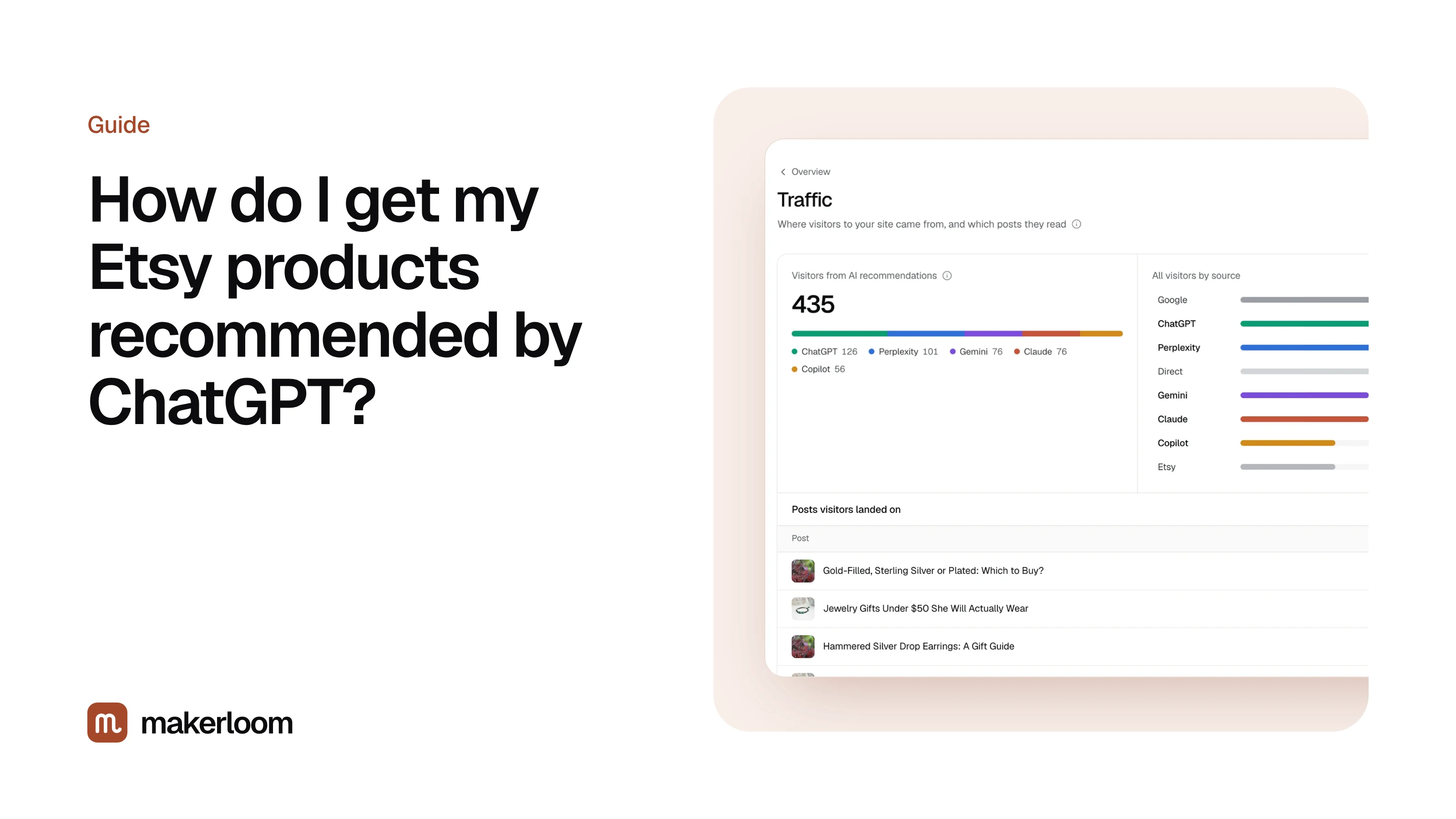
Most assistants pass on where a visitor came from, so you can count AI visits. Makerloom's dashboard shows visits from ChatGPT, Perplexity, Gemini, Copilot and Claude separately, and which post each visitor landed on. See Traffic and AI visits.
You can also test by hand: ask ChatGPT and Perplexity the questions your posts answer and see which sources they cite. Answers vary between runs, so check several times over a few weeks rather than once.
A realistic timeline
AI search follows web search. A new site usually needs to be indexed and get some search visits before assistants start citing it. Expect the first AI visits a month or more after your first posts, growing as the site builds up pages and trust. For most shops AI visits start small next to Google, but they arrive with high intent: someone who tapped a recommendation is close to buying.
Common questions
Can I pay to be recommended by ChatGPT?
Not in the regular answers. ChatGPT's shopping results and citations are chosen from the web. Some assistants show ads separately, labeled as ads.
Does ChatGPT read Etsy?
It can find Etsy pages through search, and sometimes names Etsy shops. But it's far more likely to recommend a product featured on a clear guide page than one listing among thousands.
How many posts do I need?
There's no magic number. A steady run of specific posts, one or two a week, builds up quickly: after three months that's 15 to 25 pages, each targeting a different question.
Is this the same as SEO?
Mostly. People call it AEO (answer engine optimization) or GEO (generative engine optimization). The extra emphasis is on quotable answers, specific facts and tables. See How to get your Etsy shop on Google.